
7 Signs Your Retaining Wall Is About to Fail (And What Asheville Homeowners Need to Do Now)
Whether you built your retaining wall five years ago or inherited one when you bought your house, the warning signs look the same. Cracks. Leaning. Water where it shouldn't be. Soil disappearing behind the wall.
In Western North Carolina, failing retaining walls are one of the most common problems we see.
The good news is that retaining walls almost never fail without warning. They send signs for months, sometimes years, before they actually go. And the difference between a small repair and a full rebuild usually comes down to how early you catch it.
Here's exactly what to look for.
Why Asheville Is Uniquely Hard on Retaining Walls
Before we get into the warning signs, it helps to understand why walls fail faster in the mountains than almost anywhere else.
Three things work against retaining walls in Western North Carolina:
Clay rich soils. Most of Buncombe County sits on dense, heavy clay. When it rains, clay absorbs water and swells. When it dries, it shrinks. That constant expansion and contraction puts enormous pressure on a wall that was designed for stable ground.
45+ inches of rain per year. Asheville gets roughly 50% more rainfall than the national average. All of that water has to go somewhere. If your wall doesn't have proper drainage behind it, that water saturates the soil and pushes against the wall with thousands of pounds of force. This is called hydrostatic pressure, and it's the number one killer of retaining walls.
Freeze and thaw cycles. Asheville winters bounce above and below freezing dozens of times each season. Water trapped in soil and in the wall itself expands when it freezes. Over a few years, those tiny expansions add up. Blocks shift. Mortar cracks. Footings heave.
When you combine all three of these factors with the steep slopes that come standard with mountain living, you've got the most demanding environment for a retaining wall anywhere in the state.
A wall that might last 30 years near the coast can start showing problems in Asheville within 3 to 5 years if it wasn't built with these conditions in mind.
7 Warning Signs Your Retaining Wall Is Failing
1. The Wall Is Leaning or Tilting Forward
This is the one most people notice first. You look at the wall from the side and the top is farther out than the bottom. Even a small lean (an inch or two) means the soil pressure behind the wall is winning.
A slight lean after many years of service is not unusual. But if the lean appeared recently, or if it's getting worse season to season, the wall is actively failing. Do not wait on this one.
2. You See Cracks (Especially Horizontal Ones)
Not all cracks are created equal.
Horizontal cracks are the most serious. They run along the length of the wall and usually mean the lateral pressure from the soil is more than the wall was designed to handle. Think of it like bending a ruler. The outside edge is being pulled apart.
Stair step cracks follow the mortar joints in a diagonal pattern. These typically signal uneven settling, where one section of the footing is sinking while another holds firm.
Vertical cracks at the ends or corners can mean the wall is being pulled apart by sections moving independently.
Hairline cracks from normal settling are one thing. But if you can fit a quarter into the gap, or if the cracks are growing (mark them with a pencil and check back in a few weeks), the wall needs professional attention.
3. The Wall Is Bulging in the Middle
A bulge means the wall is bowing outward under pressure. This is different from leaning. With a lean, the whole wall tilts. With a bulge, the middle pushes out while the ends stay put.
This is one of the most urgent signs of failure. A bulging wall can collapse with very little additional warning, especially during or after heavy rain.
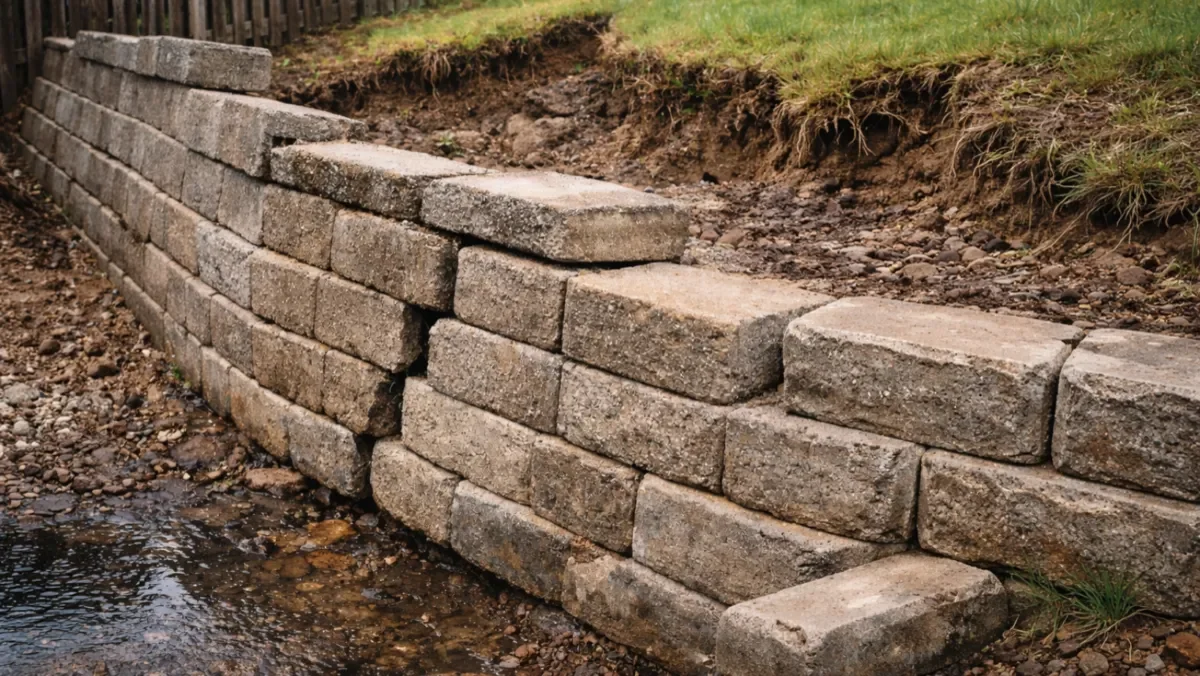
4. Water Is Pooling Behind or Around the Wall
After a rainstorm, walk behind your wall (if you can access it) and look at the soil. Is it soggy? Is water sitting at the base? Are you seeing water seep through the face of the wall?
A properly built retaining wall has a drainage system behind it: gravel backfill, a perforated pipe, and weep holes that let water escape. When those systems are missing, clogged, or were never installed in the first place, water builds up and pushes.
Wet soil weighs dramatically more than dry soil. A wall that was holding back dry clay just fine can buckle when that same clay gets saturated after a week of Asheville rain.
5. The Soil Behind the Wall Is Sinking or Pulling Away
If you notice that the ground directly behind the top of the wall is dropping, creating a gap between the soil and the wall cap, that's a sign of internal erosion. Soil is washing out through gaps in the wall or through failed drainage systems.
You might also see small sinkholes forming a few feet behind the wall. This is the same issue on a larger scale.
This is especially common in Asheville after Hurricane Helene and the sustained heavy rain events that followed. Walls that were marginal before the storm are now showing accelerated failure.
6. Blocks or Stones Are Shifting Out of Place
Walk along the face of the wall and look at the joints. Are blocks that were once flush now offset? Can you see gaps opening between stones? Are cap stones wobbling or loose?
Individual block movement means the wall's internal structure is breaking down. The geogrid (the reinforcement layers buried in the soil behind the wall) may have pulled loose, or the base course may be shifting.
7. Nearby Pavement, Patios, or Structures Are Moving
Sometimes the wall looks okay from the front, but the evidence shows up elsewhere. If the patio above the wall is cracking, if the driveway is developing new cracks near the wall, or if a nearby deck post is tilting, the soil the wall is supposed to be holding is already on the move.
This is the most expensive version of the problem because now you're dealing with collateral damage.
Why Most Asheville Retaining Walls Fail in the First Place
The hard truth is that most retaining wall failures trace back to how the wall was built, not how old it is.
Here’s what leads to failing walls:
No drainage system. This is by far the most common issue. A gravel backfill layer and drainage pipe should be standard on every wall. But they cost money and take time, and they're invisible once the wall is finished. So some contractors skip them.
Inadequate footings. In Asheville, where freeze and thaw cycles are constant, the footing needs to be deep enough to sit below the frost line. Shallow footings heave. Heaved footings crack. Cracked footings fail.
Wrong backfill material. The soil behind a retaining wall needs to drain freely. Clay does not drain freely. If a contractor backfills with the same clay they excavated, the wall is holding back a future wall of water.
No engineering on tall walls. In Buncombe County, any retaining wall taller than four feet requires an engineered plan and a county permit. Walls taller than six feet near a road need additional screening. Walls providing more than five feet of vertical relief within 50 horizontal feet need a registered design professional's approval. These aren't suggestions. They're code. But not every contractor pulls permits.
Skipping geogrid reinforcement. Geogrid is the woven fabric that ties the wall to the soil mass behind it. Without it, you're relying on the weight of the blocks alone to resist all that lateral pressure. On a steep Asheville slope, that's a losing bet.
What to Do If You Spot These Signs
If your wall is showing one or more of the warning signs above, here's the honest reality:
Caught early, many walls can be stabilized or repaired. Drainage can be added or improved. Sections can be rebuilt. Reinforcement can be installed. The cost of a targeted repair is almost always less than a full rebuild.
Wait too long, and you're starting over. Once a wall has moved significantly, patching it back together is like putting a bandage on a broken bone. The footing, the backfill, the drainage, the reinforcement: it all has to come out and be done right from scratch.
What a Proper Assessment Looks Like
When Thorpe Landscapes evaluates a retaining wall, we look at the full picture:
The wall structure itself: cracks, lean, bulge, block condition
Drainage conditions behind and around the wall
The footing and base: has it settled, shifted, or heaved?
Soil conditions and slope grade
Whether the original build included geogrid, proper backfill, and permits
We don't just look at the symptoms. We figure out what caused them. Because a wall that failed once will fail again if the root cause isn't addressed.
Ready to Get Your Wall Assessed?
If your retaining wall is showing any of the signs above, don't wait for the next big rainstorm to make the decision for you.
Contact Thorpe Landscapes today for a retaining wall assessment. We serve homeowners across Asheville, Black Mountain, Weaverville, Hendersonville, and all of Western North Carolina.
Whether your wall needs a targeted repair or a full rebuild done right, we'll give you a straight answer and a clear plan.